
Language Development
Language proficiency rather than age
Across all levels, we place a strong emphasis on developing practical target language skills, and students are expected to actively speak the language during every session.
To ensure the best fit, entering students are carefully assessed and placed into the correct language level based on their actual proficiency, rather than their age or prior exposure.
By seamlessly blending listening, speaking, reading, and writing with cultural practice, we create a complete, immersive communication experience.
Lesson plans are thoughtfully designed for students from 1st Grade through High School.
Your child will love participating in our engaging collection of songs, games, art, and independent movie-making projects.
Because we utilize 1-on-1 instruction, your student receives deep personal interaction and immediate feedback from their instructor, allowing SpoLang to consistently deliver a rich, fun-filled, and highly interactive class.
SpoLang creates an environment in which learners literally live the language.
SPOLANG’S SEVEN STAGES OF SECOND LANGUAGE ACQUISITION
Anyone who has been around children who are learning to talk knows that the process happens in stages—first understanding, then one-word utterances, then two-word phrases, and so on.
A child learning a second language moves through seven predictable stages: Preproduction, Silent Period, Early Production, Simple Phrases, Basic User, Independent User, and Proficient User.
How quickly a student progress through the stages depends on many factors, including age, family background, level of formal education, and length of time enrolled at SpoLang.
SpoLang ties instructions for each student to his or her particular stage. Knowing this important information about each student allows SpoLang to work within his or her zone of proximal development—that gap between what students can do on their own and what they can with the help of more instructions.
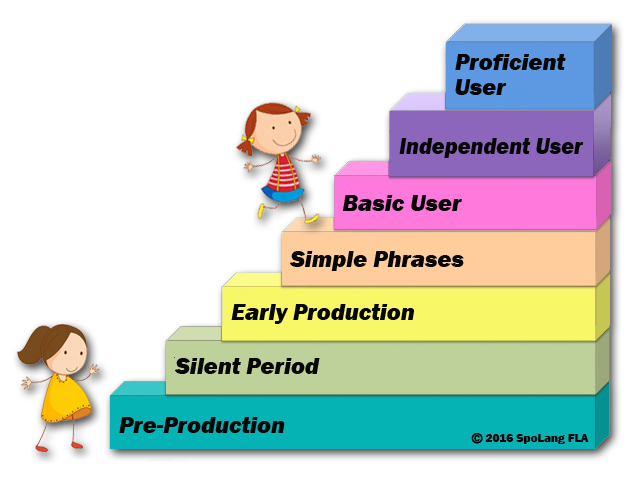
• PROFICIENT USER:
– near-native level of speech
• INDEPENDENT USER:
– excellent comprehension
– makes few grammatical errors
• BASIC USER:
– good comprehension
– questions requiring more than a sentence response
– misunderstands jokes
• SIMPLE PHRASES:
– improving comprehension
– can produce simple sentences
– questions requiring phrase or short-sentence answers
– grammar and pronunciation errors
• EARLY PRODUCTION:
– limited comprehension
– produces one- or two-word responses
– key words and familiar phrases
– uses present-tense verbs
• SILENT PERIOD:
After children realize their first language is not working, they enter a silent period in which they barely speak and rely heavily on nonverbal means to communicate with others. The younger the child, the longer the silent period may last.
• PRE-PORDUCTION:
– minimal comprehension
– does not verbalize
– nods “yes” and “no”
– draws and points